Saturday, October 26, 2013

Fear Through Eternity

Fear Through Eternity from Merdumgiriz on Vimeo.

This film, just released by Merdümgiriz and Emir Toğrul, strongly has the dungeon spirit.  It is for this film that the album by Yayla, also titled "Fear Through Eternity," was made.  The closest thing I could compare it to is the music video for Mortiis - Reisene til grotter og ødemarker, however this is even more experimental and minimalistic.  It definitely requires patience and an open mind, however I feel that if you give it your time then you'll find it to be a powerful and rewarding journey.

If you would like to purchase the film, or just find more information about it, you can do so here: http://merdumgiriz.org/FTE.html 

Thursday, October 17, 2013

Lord Lovidicus - Forgotten Ruins


The feeling of reward in this album is very strong.  One gets the sense of staggering heights, awe-inspiring vistas, and a dark perilous journey.  The album is slow-paced, structured like a grand legend, and has the majestic melodies to make it all work.  The moments of trudging discomfort act as a powerful contrast to the plateaus of clarity and conquest.  In the way it travels from darkest depths to greatest heights, it gives the listener a sense of vertical travel, which matches well the themes suggested by the song names, "The Mountain Stronghold Shrouded In Fog And Shadows," and "Scaling The Crevasses Of Fyrelight Cave."

This is not an easy record.  From the get-go we feel the tension of uphill ascent.  This album might be following the early Mortiis structure, but its progression is so much more towering.  Permeating the album is an impression of dualistic movement, between difficult struggle and breathtaking visions.  There is all the mood of ancient magic, of mythic castles and rotting tombs speckling the landscape like gravedust.  But then in contrast to that gravedust is the veil of night, and the stardust dotting the firmament overhead.  This is where I hear the vocals in track one… a glorious height out of all dungeon synth.  Lord Lovidicus experimented with the two thirty-minute track structure of Mortiis, and seems to have immediately grasped it.  One feels like they climb to such heights that they gaze on the realm of the gods.

It is strangely thematic.  The return to certain melodies after a long while gives it the feeling of a journey.  I've wondered for a while whether longer track-lengths might suit the ideas of dungeon synth better than the standard black metal lengths they currently have.  I feel like this work validates that.

This album isn't perfect, however.  There are moments that do drag a bit, and the repetition can get a bit wearisome when the ideas aren't particularly striking on their own.  But for the most part the slow moments function more as a brief rest, for the contemplating mind to reflect on the strange paths it has taken, before rising again to otherworldly panoramas.  It will require patience from the listener (even as a ds album), a willingness to allow the music to, at times, fall to the background of one's present thought.  It is minimal in this way, somewhat detached, but this detachment just highlights the moments of exhilaration and wonder more strongly.  But that said, the album might be a bit on the long side, especially for one that relies on simplicity and repetition so strongly.  Also, the sound of the synth tones, while pleasant, are somewhat standard for the genre, and don't stick out much.  Everything is pretty clean and well-produced, I'm guessing a product of software.  It also seems, to my ears, that the compositions were programmed rather than performed; I'm not sure whether the coldness of this technique adds or detracts from this album, although I personally prefer the more rough and organic performances most of the time.

So, while I feel there are several weaknesses in this record, it still holds up as one of the best dungeon synth albums this year.  It went back to the roots, invoking the sprawling structural quality in Mortiis that is often overlooked in recent expressions of the dungeon style, and it did it to great success.  It's enthusiastic about the vision, almost a call to arms.  The only lyrics to be found on the album, toward the end of the second track, really say it all: "Come forth.  Burn your darkest flame.  The answer lies ahead." 


It's free, and I strongly recommend checking it out.  It can be downloaded here [link from the artist's youtube page].

Friday, August 9, 2013

Brief Update

This is not a proper post, but there are a couple things I'd like to bring up that I think will be of interest to dungeon listeners.

Firstly, it's been brought to my attention that someone has produced a dungeon synth ezine, called "Dungeons of Darkness."  The first issue is well-done and has lots of content, including interviews with Erang and Lord Lovidicus, so I strongly suggest checking it out.  It can be downloaded here: https://www.dropbox.com/s/9nll12oucvbx3ti/Dungeons%20of%20Darkness%20magazine.pdf#

Secondly, I released a new album under my dungeon synth project, Valscharuhn, not too long ago.  I feel that it explores interesting territory, though is a lot less focused than the previous album.  It can be downloaded here: http://valscharuhn.bandcamp.com/album/journeys-adrift (and please don't pay unless you just have money to burn).

Lastly, and this is somewhat off-topic, but I wanted to express my enthusiasm for the Oculus Rift.  If you're unfamiliar with this, it's essentially a new technology that is gaining a lot of momentum right now, a virtual reality head-mounted display that actually delivers on the promise.  I received my "developer's kit" (even though I'm just an enthusiast) a little over a week ago, and it's led to some of the most astonishing experiences I've had, and this is only with demos and retrofitted software.  "Dear Esther," for instance, was overwhelmingly beautiful.  It really does feel like you're in a separate dreamworld, and I think this will change everything in terms of immersive, atmospheric art.  For anyone who is into gaming or just what a strange future we'll be heading into, it will be worth your while to research the topic and keep an eye on its developments.

Friday, July 19, 2013

Skarpseian - Skygge Slottet


There is a castle.  It is overgrown, looking like a rotting stone log jutting out of the ground, once an independent lifeform, now decaying into the earth.  But there is human life here yet: simple, traditional, natural life.  They are people who also sink into the decay of earth and ages, like a rapture for ancient nobility, a slow process of being warped and twisted by the machinations of time.  We are whisked away for the length of this album, possessed by the ghost of that lost castle.

This is another release which comes from Russia, where the interest in dungeon synth seems alive and well.  This is an album which gets the formula exactly right, but also introduces a very distinct and unique vision of dungeon synth in the process.  You almost feel like you're there, amidst the cold, rotting stones.  You can sense the terrible, horrific things going on in the immense torture chambers below, and feel grateful each day that you have food, a bed, and are not condemned to those depths.

But though this might be the castle of a tyrant, a decaying fortress sinking into the earth, there is still great majesty and regality here.  I think this is particularly present on Targenur.  The great string tone almost sounds like castle gates going up and down.  You feel the immense and glorious display of power this is, coming in off the wild trails of nature into a legendary fortress of pain and order.

My first listen of this album, I was initially put-off by what I perceived to be another "noble savage" kind of dungeon synth record, one that is simple both in voice and vision.  However, I quickly learned that Skarpseian is one of the exceptions channeling this level of simplicity.  From what I can tell, this is a calculated minimalism.  While such a thing is not uncommon in dungeon synth, what is unique here is that it seems both self-aware and also pure.  What I mean by this is that it feels authentic.  It doesn't feel like it's intentionally "dumbed down," but rather that it's conjuring these ancient feelings in a way that is simply primitive: a direct, straightforward voice.  A hard feat.  Though the voice is straightforward, the message and atmosphere are cyclical and spiraling inward into oblivion, a hazy stupor of life that fades before it's even realized it'd begun.  It is an atmosphere with immense depth.

The sound of the synths here are brilliant.  Each of them seems to embrace the ugliness and uniqueness of discarded sounds from decades past.  This allows for both the immediate feelings of decay, as well as seeing the flowers and mushrooms that bloom from such a process, the spirit of forgotten history.  Skarpseian has a wonderful ear for which tones have something to offer apart from being vintage, that they each have their own beautiful unheard voice, and the artist expresses them very raw and confidently.  This has a tremendous effect, making the work seem both primitive and distinctly noble, naturally a perfect vibe for the concept of a "shadow castle."

And something must be said of the album art.  I'm personally not sure whether it's new or old, well-known or original, but it fits fantastically with the sound of the music.  It has all the misty atmosphere, the overgrown/decaying quality, the cold-looking land on the horizon, the tinge of greenish-brown earthiness, and the two black figures on the bridge, completely opaque, showing the presence but insignificance of human life in this vision.  All the major points in the music can be found by studying this art while listening, which should be the ideal goal of album art.

I've listened to this work a handful of times already, and it's grown on me more each time.  This is an album which is very focused on the vision, and because of that it's able to go much deeper than most dungeon synth I've listened to.  This album might rival some of the best, assuming it holds up on further listens.  


I strongly suggest checking it out: http://skarpseian.bandcamp.com/album/skygge-slottet-2

Wednesday, July 10, 2013

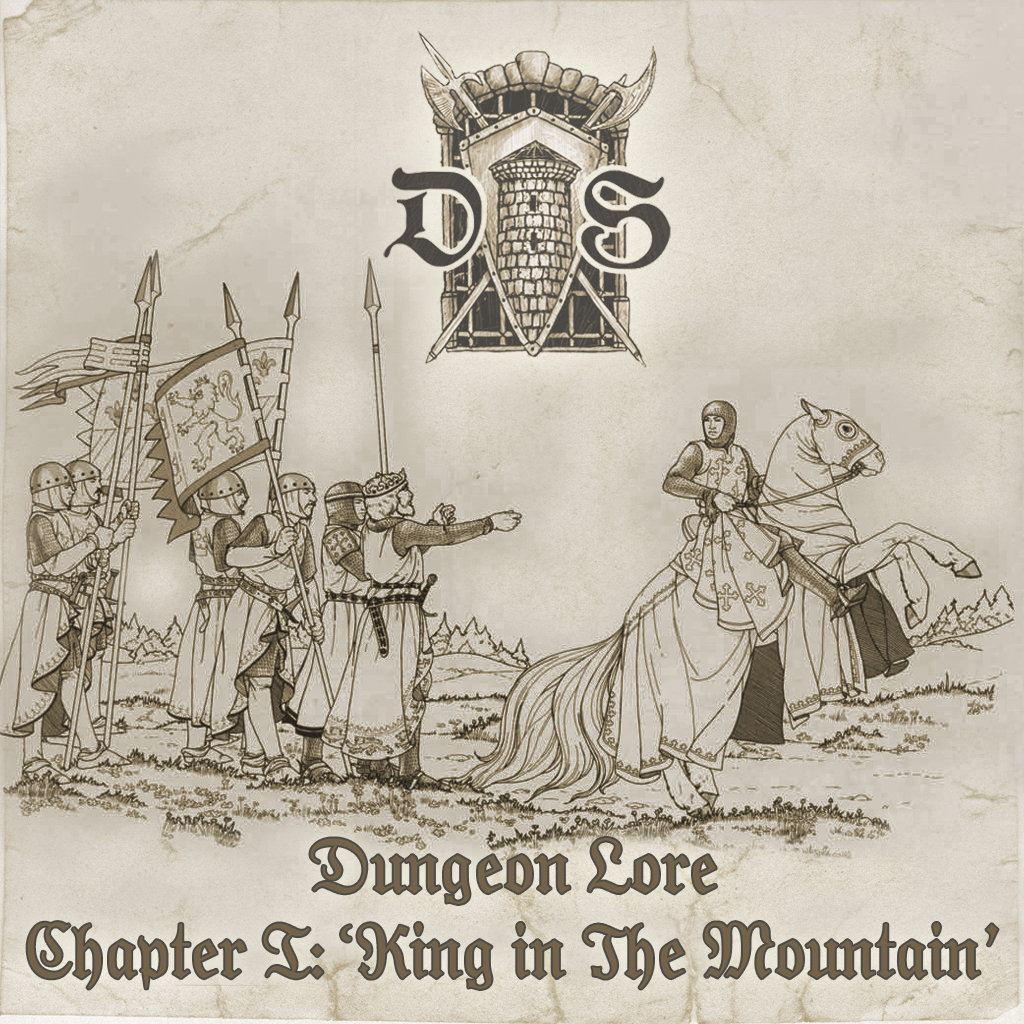
Dungeon Lore Foundation - Chapter I: 'King in the Mountain'


On the horizon lies several noble firs, a thick layer of fog, grass wet with morning dew, and a slowly approaching army of medieval warriors.  Here one will find glory and nobility, castles rising strong from the cold grounds of the north.  Here we find a vision of the medieval that is alive and strong, thrusting ourselves in the midst of that ancient scene.

Compilations are a rare thing in dungeon synth, and I'm not sure the genre is very well-suited to them, however in the case of this album it serves a pretty good purpose, which is introducing us to a number of the currently-active Russian dungeon synth artists, particular those associated with the VK dungeon synth page (who are the ones that put together this compilation).  Since compilations are varied by their inherent nature, I think this review would be best served going track-by-track.

The first track, Saga About Old Sword And Forgotten Glory, is very clean and tight, folky, epic, with war drums, battle samples, a shrill flute, and a heavy consistent brass.  It seems to glorify ancient battles, and has a strong underlying pagan feeling, to the point of being almost reminiscent of new age music, but I think it's subtle enough to just add a bit of a unique flavor to a decidedly dungeon synth track.  It fits the theme of the album as well.

The next track is on the opposite spectrum of dungeon synth: cheap keyboard, very little reverb, and sloppy playing.  This one is more along the lines of ponderous medieval melancholy, similar to Født til å Herske.  A sparse, foggy landscape of isolation and yearning.  This is the familiar sound of a lone, melancholic dreamer wandering amongst cold plains and decrepit ruins.  Not bad, but doesn't really explore any new territory.

The third track is glorious and naturalistic, really does convey the feeling of some noble creature or spirit soaring over a landscape and amidst the clouds, seeing the trees, mountains, and castles in the vista below.  It doesn't seem to go anywhere though, more like a brief glimpse into this animalistic experience.  I'm almost reminded of Nest.

The fourth track is repetitive, bright, and ancient.  Really strong sense of nature and sunlight, like a pagan daydream, but not that hokey renaissance-fair type paganism, the real thing.  Unique sort of atmosphere here, really visual and serene.  Over repeated listens this track has grown on me strongly.  The artist has a good ear for the level of minimalism best suited for daydreaming and being immersed in the atmosphere.  Not a very dynamic song, but very effective at giving the listener a sense of place.

The next track, Dungeon Ghost, is a bit repetitive and simple.  Feels somewhat like a mantra of some sort, a small single line of runes carved into a forgotten stone.  Feels like it's attempting to represent the impenetrable past, a past which is entirely alien to us today, incomprehensible even in its simplicity.  That said, while it does have an effective atmosphere, I think it's an atmosphere a bit too simple to repeat as often as it does.  It should either be more dynamic or half the length.

Merlin-Sorcerer's Awakening is interesting, bombastic and fantastical, perhaps leaving dungeon territory a bit.  It seems like this song is attempting to be a bit more symphonic, with a quite dynamic composition, however opposite the previous song, it seems to move much too quickly to ever let the listener explore the atmosphere on his own.  I think dungeon synth necessarily needs to be a bit more detached, not engaging the listener quite so directly.

Sunrise Over the Mountain Forest feels somewhat uninspired.  It's tracks like these that make me wonder whether musical experience is a hindrance in making dungeon synth.  This artist seems to have quite the traditional musical ability, however I sometimes feel that this leads to a "by the books" approach, which can act as a crutch.  Or perhaps the vision being expressed just doesn't resonate with me so strongly; that can very well be the case here, since it is one of bright sentimental serenity, an atmosphere which I personally do not value much. 

Return to Erebor is very cool.  It is synthy, with quite a few spacey patches, mixed in with the familiar medieval ones.  Like many of the tracks here, it is heavy on the percussion, but that's not a bad thing.  It makes the track quite powerful in this case.  A whole album of this sort of material, I would question whether it is "pure" dungeon synth, but that's irrelevant since it's interesting and original.

The last track is very vast and final, with a hint of menace, a sense of things coming to a final pass.  Great for an ending.  The lack of a riff-based structure and percussion make it seem a bit unrooted, compared to the sound of a lot of ds, and that works really well here and it still really has the dungeon tone.

**************

The unifying theme of this album is of the mythic element of a king/hero who is hidden away, before arriving out of the darkness into the light of day.  That feeling is conveyed pretty well here, and if the planned nine albums pan out, I'm guessing it might be approached as the traditional hero cycle, which might make the whole collection of works a very unified and powerful vision of dungeon synth.

Overall the album seems pleasant but unfocused, bright and ancient.  It has the strong Russian pagan vibe to it, but without descending into any reenactment-festival type sounds.  It's not a "must-listen," however it does a great job introducing a lot of the modern Russian dungeon synth projects, particularly those associated with the VK dungeon synth page.

It's fascinating as an original dungeon synth compilation, giving many short differing glimpses into that other world of fantasy dreaming.  My issue with it, however, is that I think dungeon synth requires longer forms to come to a cohesive meaning.  At best I was only able to get a sense of what was being communicated, rather than the complete vision.  I think that comes down to this genre being about individualistic expression.  I'm skeptical whether this can ever be fully realized in compilation form, however I'd love to be proven wrong.  In any case, it's definitely a good way to learn where to delve further with these very talented artists.


Check it out, it's free to download: http://dungeonlorefoundation.bandcamp.com/

Monday, May 27, 2013

Interview with Curwenius of Mitternacht


Andrew: To start, though you've had several impressive dungeon synth epics since back in 2002, many readers might be unfamiliar with your material.  How would you describe your personal vision within this style of music for those who have never heard it?
Curwenius: Mitternacht’s first album (“The Desolation of Blendenstein”) was highly influenced by symphonic black metal keyboards, Summoning, dark ambient and, of course, Mortiis.  My aim was composing music with a lot of instrumentation, alternating passages of fast percussion and melancholic moments. After composition, it was a natural process to complete the music with a fantasy storytelling.
The second CD ("The Raise of the Secret Cities) followed the line of the first one with a more symphonic instrumentation component, keeping the storytelling.
The third release ("8 Visions of the Time Pilgrim") was totally instrumental, delegating in the track titles the concept of the album. There is a fourth album already composed and recorded, in which Mitternacht would return to the fantasy storytelling along the concept of the CD. Release date has not been scheduled yet.
Andrew: Your first two albums contain the vocal narration of lofty fantasy events, but this element is missing in the third.  Do you feel that dungeon synth as a genre is a good avenue for atmospheric storytelling?  Do you think it might be somewhat like opera when utilized in that way?  And is that storytelling quality diminished at all when it is purely musical, such as your third album?
Curwenius: Dungeon synth is perhaps the most adequate ambient genre for storytelling, even without lyrics. You can tell a story only with track titles: the composition of each track should be climactic enough to take the mind of the listener to the place you want to take it; being purely musical could impact (or not) in the quality of the storytelling. Of course, adding lyrics always lets you expand the story. But not the kind of storytelling in opera: I think that in opera the story has much more preponderance over the music, and the music (beautiful or not) becomes a tool for a theatrical piece, under my point of view. I understand that is not the common opinion about opera.
Andrew: I notice that your third album, "8 Visions of the Time Pilgrim," based on the song titles, seems to be dealing with historical themes, essentially covering primordial earth until World War II, but channeled through a fantasy lens.  What are your thoughts on contemplating history with a fantastical mindset?
Curwenius: When I was conceiving the concept of this album, I wondered what could be the impression of mankind's behavior for a completely external observer. Of course, that impression could not be good. And, what if that observer could watch different moments of mankind's history? That is the reason for the album title: "8 Visions of the Time Pilgrim". That "pilgrim", an external observer (a fantastic creature, a space traveler, whatever), would testify the rapid movement from mankind against nature to mankind against mankind. That was what I tried to explore with this concept.
Andrew: What are your thoughts on the relation between fantasy and the real world?  Is pure escapism a noble path?
Curwenius: I don't consider fantasy to be escapism. In fact, they are even antagonist concepts. Fantasy, in an artistic context, is the most daring way of facing reality. I mean, the fantasy in art allows people to face their most feared feelings, situations, and monsters, and for "monsters" I'm talking about the self's dark side and the others'. After the artistic creation, those fears and monsters would take shape as werewolves, nightmare creatures, evil spirits, forest goblins, and so on, in a sublimation process.
Hedonism, addictions, consumerism, snobbery: under my point of view, those are the real forms of escapism.
Andrew: Do you make this music mainly for yourself or for others, and why?
Curwenius: I make music for my own enjoyment and for others to listen. I think the joy of making music cannot be completely fulfilled if there is none to listen it. It's like writing a story that is not going to be read by anyone.
Andrew: What is your typical composition/recording process, and what equipment do you use?
Curwenius: When I want to start a new work, usually the idea of the concept and the composition line appears simultaneously. Once I've started, perhaps the initial idea is discarded and replaced for another one that I could consider better. That counts for the concept and for the music.
So, when the structure of the theme has a clear shape, then comes the process of making melodies and choosing instrumentation, keeping in mind if this track would include lyrics, sound effects, voices or all of them. Now, with the composition finished, it starts a process of correction that could modify (deeply or not) the track. After that, I finally record the music.
For recording, I've utilized my own digital studio (not expensive but useful), including a specialized audio card and a midi keyboard. Also I use some well-known PC based recording, mixing and midi tools.
Andrew: You're certainly the first South American dungeon synth artist I've communicated with, and as far as I can remember at the moment, the only one I know of.  How do you feel your locality in Argentina influences your taste and creativity?  Was it through the internet that you were able to familiarize yourself with this style, or is this sort of music present in your local metal underground?
Curwenius: I think my locality has no direct (positive or negative) influence in my musical taste. I've listen most metal genres since I was very young, always looking for more existent subgenres of this music. Eventually, I met dark ambient. I was always more attached to keyboards than guitar and bass (I like both anyway), despite my metal roots, so Mortiis, Pazuzu, Die Verbantenn Kinder Evas, Dargaard were real findings to me, and by 2000 I've decided to start my own project, Mitternacht.
At this point I must make an acknowledgement to Furias Records. First for letting me easily reach many titles of every underground music genre, most of them very difficult to find here and, after that, for taking the chance of releasing my albums. That was just before the internet explosion, at least in my country. Since then, internet has been an incredible source of valuable information (just like your blog).
Andrew: What are your religious and political stances?
Curwenius: I'm not a practicant or a churchgoer, but I'm a baptized Catholic. I think religion is a good thing for the human intellect (therefore, for his life), in spite of the fact that they have been presented, religion and intellectualism, as antagonists.
Regarding to my political instances, I'll just say that I don't like politicians and I think that politics and ideologies are bad things. I've heard that just saying that is making a political statement and having an ideology. I disagree, I believe in good deeds made by good people, not in a platform of ideas. Instead of politics, I like to think of civic-mindedness.
Andrew: Do you have any concern for whether the internet will harm this style of music, since it seems to have found somewhat of a home online?  Do you think shining a light on the darkness might break the spell to some extent?
Curwenius: If I correctly understood the question, no, I'm not concerned. In opposite way, I think that Internet is a great channel of diffusion for this style of music. This is a way that could lead more labels to take the chance of releasing albums devoted to this genre. Thanks to the Internet we can discover without delay that a musician, no matter in which country they live, has composed a work that we not only like, but would buy also. This interview and the way we got in touch is a perfect example. I was thinking that dungeon synth styled dark ambient music hadn't found a specific group of listeners, but I've found your blog, and thanks to your blog, I've discovered a lot of dungeon synth projects, some of them superb, and I must say it's encouraging to me for composing more and more music, exploring more and more deeply this and other genres of dark ambient music.
Andrew: Are there any final words you'd like to add?
Curwenius: First of all, I would like to thank you for taking into account my work, for considering it involved with dungeon synth music, for giving me this space for expressing me and finally for your initiative and your great work in the dungeon synth blog.
I hope more labels, in the future, take the chance of releasing alternate subgenres like dungeon synth.
Andrew: Thank you very much for your kind words and for speaking with us.


You can purchase the albums from Furias Records, where one may also find Curwenius' pagan black metal project, Heulend Horn (sample track).

Monday, April 1, 2013

Mortiis - Ånden som gjorde opprør


A great purple mystery looms high, a vast stone temple stretching into the starry sky.  A foggy shroud clouds the mind of the wanderer as he stumbles through a strange landscape filled with ancient towering monuments, rotting tombs, fearsome beasts, and unholy necromancers.  It is a place for lost spirits, where the unknown is not some abstract concept, but rather a permeating experience of the world.  One meanders through, over, and under this setting of dreamlike beauty, simply soaking in the primal grace of each new vision.

Of course this is one of the defining masterpieces of dungeon synth, mandatory for anyone claiming to have interest in the genre.  It is very similar to "Keiser av en dimension ukjent" in style as well as tone.  It has gone through two different artworks, the first being a purple landscape with several shots of Mortiis in his famous troll mask and attire.  The second cover for this album, implemented first in 2007, is my personal favorite of John Bauer's artwork (whose fairy tale paintings were also used for "Keiser av en dimension ukjent" and "Crypt of the Wizard").  I'm not familiar with the tale associated with the illustration, however the contrast of darkness, magic, and a sort of bright mystical innocence is perfect for the music here.

This is an album that one must get "caught in the flow" for.  It's a cosmic stream upon which a young entity is drifting.  Sometimes it is slow and majestic, with colorful, sparkling visions to behold on either bank, but at other times one hits the rapids, a grand medieval skirmish.  It is an album perfect for daydreaming, which I personally consider to be the primary mood dungeon synth caters to.  It is so magical because it gives the listener the power!  It is not its own fantasy world, so much as providing a set for contemplation, where the listener can build their own fantasies (the exceptional art of it is connecting to the listener in a parallel way that allows such daydreaming).

The music, of course, is simplistic.  It uses the same vintage synthesizer found on all the Era 1 Mortiis albums.  It seems, and one can read from interviews with Mortiis himself, that he did not know how to "properly" play the keyboard, but if ever there was evidence that grand artistic visions could be created through raw inspiration, it can be seen here.  Many might be capable of performing this work, and its formula is a relatively easy one to follow, but very few dungeon synth records reach such majestic heights.  Though it is quite similar to "Keiser av en dimensjon ukjent," the primary difference is that it is more adventurous and not so introspective.  Mortiis just explores the mystifying inner fantasy land he has created, and is not questioning "why?" or reflecting so much.  This work is much more about being in awe of this realm, content to wander about it, taking in all of its atmosphere and wonder.  It seems more fresh, green, youthful, and colorful than the two works preceding this, as if a grand magical kingdom started to bloom, a spring to the winter that was "Født til å herske" and "The Song of a Long Forgotten Ghost."

The (translated) lyrics of the second track go as follows:
Many years have passed since the tyrant - the guardian
of all keys and the master of the time-walls
was spit out. By a weak human she...he
was not loved by the elements of nature.
Neither earth nor water was held high by him,
he hated the nature, the earthly unknown
In this Mortiis is possibly taking a stance on dreams and fantasy.  One is "spit out" into a world of biology and instincts, pressured to fit within a certain framework of his fellow mammals, and yet, that "tyrant" might feel another calling... And so the dungeon synth dreamer takes up his skull-topped staff and wanders into the unknown world within, isolated and lonely, but able to experience the magic of lost ignorance.  Nature will contradict those instincts, the logic of which goes "mimic your brethren, reproduce," and yet he heeds the call of the unearthly realm, behaves quite contrarily to all his instinctual urges and the examples around him, and so the archetypes of nature curse him in their own way, its robotic children shunning that "master of the time-walls."

It is possible that these instincts would've been "natural" in a pre-civilized world, the dreamer becoming a shaman of the tribe through a symbolic death of the individual, and yet in the chaotic torment of modernity we are now experiencing, dreamers seem to fall through the cracks.  With nobody to seek their message, and no avenue through which to satiate the urges of the longing spirit, the dreamer must choose to either relent and give in to the tsunami of progressing civilization, or fight back and feel the full force of the "hate of nature," the repugnance and misunderstanding of the surface-dwelling men.

But this album is far from simply a philosophical confrontation against modernity.  In fact, it is an outright avoidance of that confrontation, recognizing the impossibility of victory, not even knowing the specific entity with which to wage battle.  It is merely the call for the escape, beckoning one toward the mystical visions within, the only place where true meaning can be found.  But this is not right either, it's not simply the call for escape, but also the gateway into the dreams of that grand decadent kingdom, one in which the listener is God, tyrant, and pilgrim.  It might destroy the earthly man who wanders that weird, forlorn trail of dungeon synth, but on that journey he will experience sights of profound obscurity, seen by few other mortals.